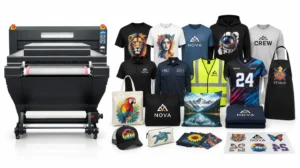
The High Stakes of Bulk Branded Merchandise
Ordering branded merchandise for an organization is not the same as buying a personal t-shirt. When a company in Kampala orders fifty polo shirts for its field team, those shirts represent the brand every time an employee interacts with a client. When a church in Juba orders three hundred t-shirts for a conference, those shirts become walking billboards across the city. When a school in Bujumbura orders uniforms for its students, those garments must survive a full academic year of daily wear and washing.
The decisions you make at the ordering stage determine whether your merchandise elevates your brand or embarrasses it. A logo that peels after two washes, a color that fades unevenly, or a size run that leaves half your team with ill-fitting shirts—these are not minor inconveniences. They are wasted money and damaged credibility.
This guide is designed to help procurement officers, event organizers, school administrators, and business owners across East Africa navigate the process of ordering bulk branded merchandise. We will cover the questions you should ask before placing an order, the printing methods that work best for different use cases, and how Sausage Tree Pictures Studio on Nasser Road has helped organizations across the region get it right.
Step One: Define the Purpose Before the Product
Before you choose a shirt style or a printing method, you need to answer a more fundamental question: who will wear this, and for how long?
Corporate workwear is different from event merchandise. A polo shirt worn by a sales team every day needs to withstand frequent washing and retain a professional appearance. The fabric weight matters. The print needs to be subtle and durable. A t-shirt given away at a conference, on the other hand, has a different job: it needs to look striking in photographs and survive enough washes that attendees do not feel they received a cheap gift.
School uniforms present another set of requirements. They must be affordable enough to order in volume, durable enough to survive a year of daily use, and consistent in color across the entire order. A parent who receives a uniform that fades differently from their neighbor’s will notice.
Sports jerseys have their own demands. They need to be breathable, flexible, and able to hold vibrant colors through sweat and repeated washing. Full sublimation printing, which dyes the fabric itself rather than applying a layer on top, is often the best choice for jerseys that need all-over designs or photo-realistic graphics .
At Sausage Tree Pictures Studio, we ask every client about the intended use before we recommend a product or a printing method. A shirt that is perfect for a one-day event may be the wrong choice for daily workwear. Understanding the use case prevents costly mistakes.
Step Two: Choose the Right Printing Method for Your Order
The East African market offers several printing methods, each with distinct advantages and limitations. Making the wrong choice can mean paying for quality you do not need or accepting durability that does not meet your requirements.
Screen printing remains the most cost-effective method for large runs of simple designs. If you need five hundred T-shirts with a one-color logo, screen printing will give you the lowest per-unit price and excellent durability. However, screen printing requires a separate screen for each color, and setup costs make small orders expensive. If your design includes gradients, photographs, or fine details, screen printing is not the right tool.
DTF printing, as we have discussed in detail elsewhere, is the most versatile option for the modern East African market. It works on cotton, polyester, and blends. It handles full-color designs with photographic detail. It requires no minimum order, so you can order exactly what you need without overbuying. For most corporate, event, and promotional orders, DTF is the best balance of quality, flexibility, and cost.
Sublimation printing is the specialist’s choice for polyester garments and all-over designs. If you are ordering sports jerseys or performance wear where the design must extend across the entire garment, sublimation produces results that no other method can match. The colors become part of the fabric itself, so there is no cracking or peeling because there is no applied layer. The trade-off is that sublimation works best on light-colored polyester, not on cotton or dark fabrics.
The key is to match the method to the job. A reputable print shop will tell you when a different method would serve you better, even if it means less revenue for them. At Sausage Tree Pictures Studio, we offer DTF, sublimation, UV DTF sticker printing, and tarpaulin printing so that we can recommend the right solution rather than forcing every order through a single process.
Step Three: Get the Artwork Right Before You Print
The single most common cause of disappointing merchandise is poor artwork preparation. A logo that looks fine on a business card may not work on a t-shirt. Fine lines disappear. Gradients that look smooth on a screen may band when printed. Colors that match your brand guidelines on paper may shift when printed on fabric.
Before you send your order to print, ensure that your artwork meets these basic requirements:
Vector files are preferred. A properly prepared vector file (AI, EPS, or PDF) scales without losing quality. If you only have a JPEG or PNG, the resolution should be at least 300 DPI at the final print size. A logo pulled from a website is almost never suitable for printing.
Transparent backgrounds are essential for DTF. When we print a DTF transfer, the design is cut out and applied to the shirt. If your file has a white background, that background will print as a white box around your logo. Ensure that your artwork has a transparent background or that your designer understands the requirements.
Consider the garment color. A design that looks striking on a white shirt may disappear on a black shirt if the colors are too dark or too similar. DTF uses a white ink base to keep colors vibrant on dark fabrics, but you should still review a digital proof before approving the order .
Size matters. A logo that looks appropriately sized on a laptop screen may be enormous or tiny when printed on a shirt. Provide your print shop with the dimensions you want for the final print, or ask them to recommend standard sizes for left-chest, full-front, and back prints.
Step Four: Plan for Sizes and Quantities
Nothing derails a merchandise order faster than a size distribution that does not match the actual recipients. Ordering equal numbers of small, medium, large, and extra-large seems logical, but real populations rarely distribute evenly. In most adult groups, medium and large account for the majority of orders, with small and extra-large making up the remainder.
If you are ordering for a known group—your employees, your students, your team—collect sizes in advance. If you are ordering for an event where you cannot know the attendees, order more mediums and larges than you think you need, and fewer smalls and extra-larges. It is always better to have a few extra shirts in common sizes than to run out of the size most people want.
For orders that will be shipped to South Sudan, D.R. Congo, or Burundi, consider ordering a small buffer of extra shirts. The cost of adding ten percent to your order is minor compared to the cost of air-freighting a resupply because you ran out.
Step Five: Understand the Timeline and Logistics
Bulk orders take time. A single custom t-shirt can be printed and pressed in under an hour. A order of two hundred shirts requires scheduling, material procurement, printing, pressing, quality checking, and packing. If you need your order delivered to Juba or Bujumbura, add shipping time to the equation.
At Sausage Tree Pictures Studio, we are transparent about timelines. For standard DTF orders, we can often complete production within a few business days, depending on quantity. Rush orders are possible, and we offer same-day custom t-shirts in Uganda for genuine emergencies. However, we always recommend planning ahead. If you know your conference is in six weeks, place your order four weeks before the event. This gives you buffer time for approvals, production, and shipping without paying rush fees.
For regional clients, we coordinate shipping to Uganda, South Sudan, D.R. Congo, Burundi, and Kenya. We will advise you on the best shipping method for your timeline and budget, and we will provide tracking information so you know when to expect delivery.
Why Organizations Across East Africa Choose Sausage Tree Pictures Studio
The printing market in Kampala is competitive. There are many shops on Nasser Road and beyond that will quote you a price for branded merchandise. What distinguishes Sausage Tree Pictures Studio is our combination of technology, experience, and service.
We invest in DTF and UV DTF equipment because these technologies give our clients the flexibility they need. No minimum orders mean you can test a design before committing to a large run. Full-color printing means your logo, however complex, will reproduce accurately. UV DTF stickers mean you can brand hard surfaces as easily as fabric.
We serve clients across the region because we understand that East Africa is not a single market. A client in Kampala has different logistics than a client in Juba. A school in Bujumbura has different budget constraints than a corporate office in Nairobi. We work with each client to find the right solution for their specific context, not a one-size-fits-all package.
Let Us Quote Your Next Order
Whether you need fifty polo shirts for a corporate team, three hundred T-shirts for a church conference, or a hundred UV DTF stickers for product packaging, we are ready to help. Send your design, quantity, and deadline to our WhatsApp line at +256 757 291 063, or visit us at Wandegeya South Wing Market in Kampala.
We will respond with a quote, a timeline, and any recommendations to improve your artwork or product choice. Our goal is not just to print your order, but to make sure the final product does what you need it to do: represent your organization with quality and consistency, wherever in East Africa it travels.