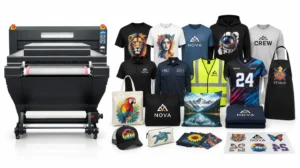
The Printing Revolution Happening on Nasser Road
If you have walked down Nasser Road in Kampala recently, you have likely noticed a shift. The familiar smell of screen printing chemicals is being supplemented by the quiet hum of digital machines. The reason is simple: businesses, schools, churches, and event organizers across East Africa are demanding more from their custom apparel. They want photographic detail. They want small batches without punishing setup fees. They want prints that survive the rigors of daily wear in equatorial heat.
For decades, screen printing dominated the region. It remains an excellent choice for massive runs of single-color logos . However, the market has fragmented. A corporate team needs twelve polos with a detailed company crest. A wedding party wants thirty t-shirts featuring a photograph of the couple. A church youth group needs fifty shirts with a complex gradient design for an upcoming conference. Screen printing struggles with these scenarios because each color requires a separate screen, and setup costs make small orders prohibitively expensive.
This is where Direct-to-Film, or DTF, printing has changed the equation entirely. At Sausage Tree Pictures Studio on Nasser Road, we have built our reputation on DTF technology because it solves the specific pain points of the East African market. Whether you are in Kampala, Juba, Bujumbura, or Kigali, understanding why DTF matters will help you make smarter decisions for your next branded merchandise project.
What Makes DTF Different from Traditional Methods
DTF printing works by printing your design onto a special transfer film using pigment-based inks. A hot-melt adhesive powder is applied to the wet print, and the film is cured. When you are ready, the design is heat-pressed onto the fabric at approximately 140 to 160 degrees Celsius . The film is peeled away, leaving the vibrant design bonded to the garment.
The technical distinction matters because it translates into real-world advantages for buyers in Uganda and neighboring countries. Unlike Direct-to-Garment (DTG) printing, which requires pretreating and works best only on high-cotton fabrics, DTF adheres beautifully to cotton, polyester, nylon, blends, and even softshell or denim . This means if you are ordering uniforms for a security company using polyester blends, or sports jerseys that need to withstand heavy sweating and washing, DTF delivers consistent color without the ink bleeding or washing out.
Perhaps the most significant advantage for the East African market is the ability to print on dark garments without additional cost or complexity. DTF uses a white ink base beneath the colors, ensuring that your logo stays bright and opaque on black, navy, or deep maroon shirts . Screen printers have to manage opacity carefully on dark fabrics, and DTG requires additional pretreatment. DTF handles it automatically.
No Minimums, No Excuses
One of the most persistent frustrations for small businesses and organizations in Kampala is the minimum order quantity. Many print shops refuse to touch a job unless you are ordering fifty or one hundred pieces. This creates a barrier for startups testing a new brand identity, for families organizing a memorial event, or for a small church that only needs twenty shirts.
At Sausage Tree Pictures Studio, we operate differently. Print and press bulk apparel with no minimum order required. If you need one custom t-shirt for a birthday gift, we will print it. If you need five hundred shirts for a corporate retreat, we will handle that too. The DTF process allows us to batch-print transfers ahead of time and press them onto garments as orders come in, making small runs economically viable .
This flexibility is particularly valuable for clients in South Sudan and the D.R. Congo, where supply chains can be unpredictable. Instead of over-ordering and tying up capital in inventory, you can order exactly what you need, when you need it. We ship custom apparel across East Africa, including Uganda, South Sudan, D.R. Congo, Burundi, and Kenya, with reliable delivery to your doorstep.
Durability That Survives the East African Climate
A common concern we hear from clients is whether a printed shirt will last. In a climate that alternates between intense sun and heavy rains, and where washing is often done by hand, durability is not a luxury—it is a requirement.
DTF prints are engineered to last. Independent testing shows that properly applied DTF transfers hold up for fifty to one hundred washes before showing signs of fading or cracking . The flexible film layer moves with the fabric, resisting the peeling that plagues cheaper heat-transfer vinyl. For schools ordering uniforms that will be worn daily and washed weekly, or for event organizers distributing shirts that attendees will wear repeatedly, this longevity translates directly into value for money.
We also offer UV DTF sticker printing services for clients who need branding that goes beyond fabric. These decals are abrasion-resistant, waterproof, and can be applied to glass, metal, plastic, and curved surfaces . A restaurant in Kampala can brand its water bottles. A hardware store in Juba can label its equipment. A tech company in Kigali can add its logo to laptops and monitors. The same shop that prints your t-shirts can also handle your hard-surface branding, eliminating the need to coordinate with multiple vendors.
Serving the Region, Not Just the City
While our physical location is on Nasser Road in Kampala—a hub that has been the center of printing and stationery in Uganda for decades—our reach extends far beyond. We understand that a client in Bujumbura or Juba cannot simply walk into our shop. That is why we have built a logistics process designed for regional delivery.
For clients in South Sudan, we offer rush custom t-shirts to Juba, recognizing that timelines in Juba can be tight and that last-minute promotional needs are common. For D.R. Congo, we handle bulk custom apparel printing with delivery to Kinshasa, including tarpaulin banner printing for businesses that need large-format outdoor signage. For Burundi, we provide no-minimum bulk t-shirts and UV DTF sticker printing to Bujumbura. For Kenya, we offer custom sublimation printing to Nairobi for clients who need photo-realistic, all-over designs.
The common thread across all these markets is the need for reliability. When you order from Sausage Tree Pictures Studio, you are not gambling on a supplier who may or may not deliver. You are working with a team that understands the logistics of East African cross-border trade and has built processes to handle it.
Why Nasser Road Remains the Smart Choice
There is a reason why Nasser Road has retained its status as Kampala’s printing capital despite the rise of online ordering and scattered print shops. The concentration of suppliers, the availability of materials, and the depth of expertise in one location create an ecosystem that is hard to replicate. When you work with a Nasser Road print shop, you benefit from competitive pricing driven by proximity to suppliers, quick turnaround times because materials are always on hand, and the ability to inspect quality before shipping.
Sausage Tree Pictures Studio is proud to be part of this ecosystem. We combine the accessibility and competitive pricing of Nasser Road with the quality and consistency that modern DTF technology allows. Whether you are a first-time buyer ordering a single sample or a procurement officer placing a regional bulk order, you will receive the same attention to detail and the same commitment to color accuracy.
Ready to See the Difference?
The best way to understand why DTF has become the preferred method for custom t-shirt printing in Kampala is to see it for yourself. Visit us at Wandegeya South Wing Market in Kampala, or send us a message on WhatsApp at +256 757 291 063 with your design and quantity requirements. We will quote you a price, confirm the timeline, and show you why businesses across East Africa are choosing Sausage Tree Pictures Studio for their branded apparel and merchandise.
Your brand deserves more than a faded print. Let us help you make it last.